This is part one of our two-part history of plastics series, beginning with early man-made…
Updated: October 2026
How Did Plastics Change From 1935 Through 1980?
Advanced Plastiform, Inc. is a custom plastics manufacturer specializing in injection molding and thermoforming. Between 1935 and 1980, advances in polymer science, wartime demand, and new production methods transformed plastics from emerging materials into products and components used throughout industry, transportation, healthcare, packaging, and everyday life.
The Expansion of the Modern Plastics Industry
In The History of Plastics Part I: 1856 Through 1935, we looked at the development of early man-made plastics, including Parkesine, celluloid, Bakelite, polystyrene, and PVC.
The next several decades brought even faster change. New polymers offered different combinations of strength, flexibility, weight, durability, and resistance to environmental conditions. At the same time, World War II created an urgent need for synthetic alternatives to materials that were scarce or difficult to obtain.
After the war, the knowledge of materials and production methods developed quickly, expanding into consumer products and industrial applications. Injection molding and thermoforming processes helped manufacturers produce plastic parts efficiently and consistently on a much larger scale.
How Were Plastics Developing Before World War II?
By the mid-1930s, materials such as Bakelite, celluloid, polystyrene, and PVC had already demonstrated what synthetic materials could offer. Research was also producing entirely new polymers with different performance characteristics.
Nylon Introduces a New Type of Synthetic Material
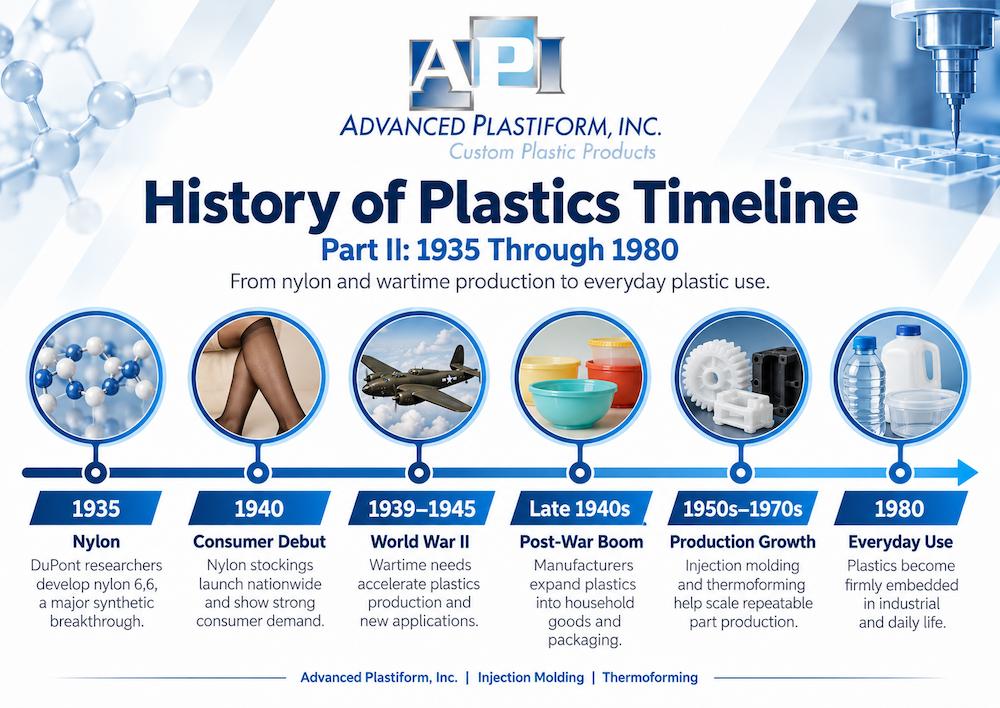
One of the most important developments came in 1935, when Wallace Carothers and his research team at DuPont developed nylon 6,6.
The American Chemical Society's history of nylon documents why the material was such an important breakthrough. The new fibers were strong and elastic, resisted water and many solvents, and had a relatively high melting point. Those properties led DuPont to select nylon 6,6 for full-scale development in July 1935.
Nylon demonstrated how a synthetic polymer could be designed around practical performance requirements rather than simply serving as a substitute for an existing material.
Its first major consumer success came through nylon stockings. The material would soon prove even more important for applications far beyond clothing.
How Did World War II Accelerate Plastic Manufacturing?

When World War II began in 1939, manufacturers faced increased demand for materials that could be produced efficiently while reducing reliance on scarce natural resources. Nylon quickly moved beyond consumer products and became useful for parachutes, ropes, and other military needs. Acrylics gave aircraft manufacturers a lighter alternative to glass, while other synthetic materials found their way into electrical parts, vehicles, protective equipment, and more.
That shift happened on a huge scale. The Science History Institute’s history of plastics notes that U.S. plastic production increased by about 300% during World War II as manufacturers looked for alternatives to materials that were harder to source.
By the end of the war, plastics were no longer viewed as niche substitutes. Manufacturers had more experience producing them at scale, researchers had a better understanding of how different polymers could perform, and plastics had proven useful for a much wider range of applications.
What Happened to Plastics After World War II?
When wartime production ended, the plastics industry had substantially greater manufacturing capacity and a much deeper understanding of synthetic materials.
The next challenge was finding civilian applications for them.
Plastics increasingly appeared in furniture, refrigeration, electronic, and transportation industries as well as in kitchen products, toys, and textiles, among many other uses. Nylon also returned to consumer markets and expanded beyond hosiery into clothing, carpeting, tire cord, seat belts, sporting goods, and other applications.
Plastics were no longer viewed primarily as inexpensive substitutes for natural materials such as ivory, silk, rubber, glass, or metal. Manufacturers increasingly selected them because the materials themselves offered useful combinations of weight, durability, flexibility, appearance, and resistance to moisture or chemicals.
Those same considerations remain important when selecting today's thermoplastic materials. Advanced Plastiform, Inc. works with materials including ABS, HIPS, polypropylene, polycarbonate, PVC, and HMWPE. Our custom plastics engineers and manufacturing partners choose the best material based on the performance requirements of the finished part.
How Did Injection Molding and Thermoforming Expand Plastic Production?
As demand for plastic products grew after World War II, manufacturers needed efficient ways to turn thermoplastic materials into repeatable parts and products.
Two processes that became increasingly important were injection molding and thermoforming.
Injection Molding
Injection molding melts thermoplastic material before injecting it into a mold. The process is particularly useful for producing detailed, repeatable components and higher-volume parts.
Thermoforming
Thermoforming begins with a plastic sheet that is heated until pliable and formed around a tool.
Modern thermoforming processes include:
- Vacuum forming for efficiently forming plastic sheet against a tool using vacuum pressure.
- Pressure forming when greater detail, sharper features, or more defined surfaces are required.
- Twin-sheet forming for producing hollow or double-walled components from two heated plastic sheets.
The right process depends on factors including part size, design complexity, production volume, material, tooling requirements, tolerances, and the
Start Your Custom Plastics Manufacturing Project Today
The advances made between 1935 and 1980 helped establish plastics as some of the most adaptable materials available to modern industry. Today, manufacturers have even more options for selecting the right material, forming process, tooling approach, and production method for a specific part or application.
Advanced Plastiform, Inc. provides custom injection molding and thermoforming services for companies in North Carolina, South Carolina, Pennsylvania, Maryland, Tennessee, Georgia, and Virginia.
Contact us today to discuss your custom plastic manufacturing project by calling 919-404-2080 or filling out our contact form.