Advanced Plastiform, Inc. is looking back at how wartime demand, new polymers, and expanding production…
Updated: October 2026
How Did Modern Plastics Develop From 1856 to 1935?
Between 1856 and 1935, plastics evolved from experimental substitutes for natural materials into materials with practical commercial and industrial uses. Breakthroughs such as Parkesine, celluloid, Bakelite, polystyrene, and PVC helped establish the material science and production concepts that would shape the modern plastics industry.
Key Takeaways
- These early developments established principles that still influence material selection, molding, and plastics production today.
- Parkesine, patented in 1856, is widely recognized as one of the earliest man-made plastics.
- Celluloid helped prove that a moldable material could be used across many different consumer products.
- Bakelite, introduced in 1907, became the first fully synthetic plastic and demonstrated the potential of engineered material properties.
- Polystyrene and PVC moved toward large-scale production by the early 1930s.
- Advanced Plastiform, Inc. works with modern materials and processes rooted in these early plastics innovations.
The Foundations of the Modern Plastics Industry
Our thermoforming team spends a lot of time thinking about the future of plastics and what kinds of innovations are on the horizon. It is just as useful, however, to look at how we got to this point of relying on plastics for everything from automobile manufacturing to medical supplies.
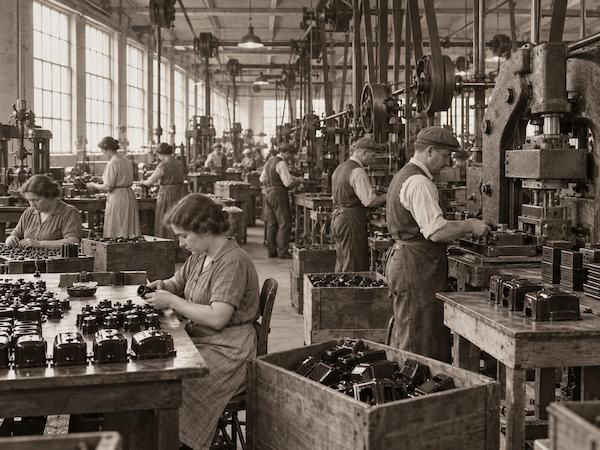
While modern plastics are relatively new in human history, their development moved quickly once inventors and chemists began creating materials that could be shaped, molded, and manufactured for practical use.
This is part one of our two-part history of plastics series, beginning with early man-made plastics and continuing through the arrival of thermoplastics
The First Plastics: Modifying Natural Materials
Humans were modifying naturally occurring materials long before modern plastics existed. Natural rubber, for example, was shaped and used by civilizations in Mesoamerica centuries before industrial manufacturing. Cellulose obtained from plants also became the basis for materials that would eventually play an important role in early plastic development.
In the 1840s, Charles Goodyear in the United States and Thomas Hancock in Britain developed methods for vulcanizing natural rubber with sulfur. Vulcanization made rubber stronger and more useful across a growing range of products.
However, it was cellulose that would lead to one of the biggest breakthroughs in the development of early plastics.
The First Man-Made Plastic: Parkesine and Celluloid
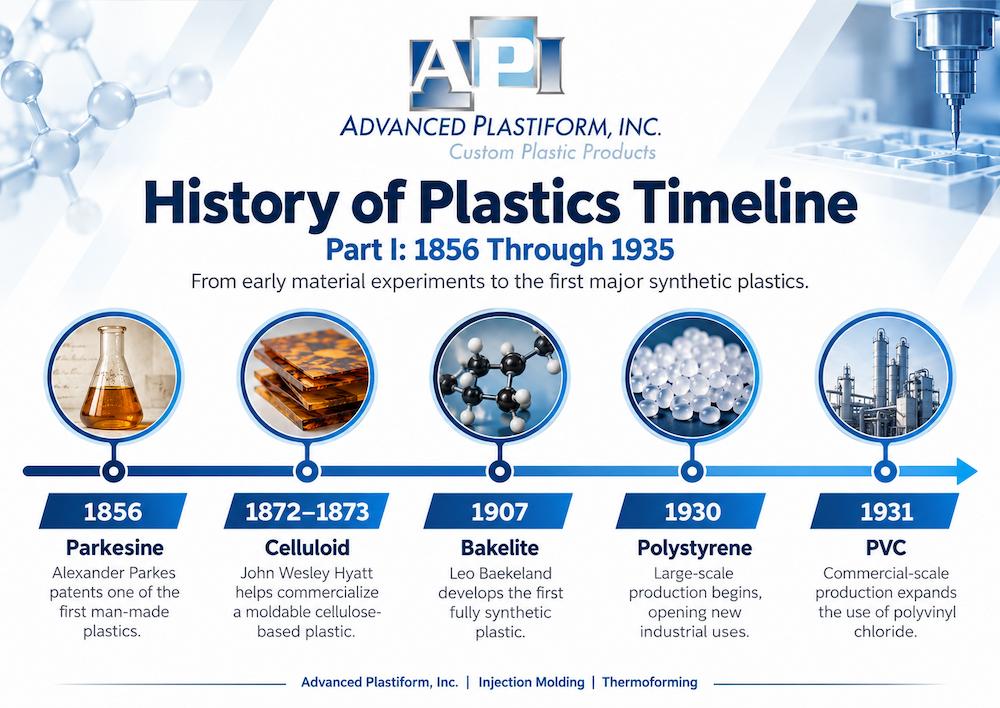
In 1856, British inventor Alexander Parkes patented a cellulose-based material that became known as Parkesine. Often recognized as one of the earliest man-made plastics, Parkesine could be heated, shaped, and hardened into finished forms.
The material demonstrated an important concept: a manufactured material could be molded into useful objects and serve as an alternative to expensive natural resources such as ivory.
American inventor John Wesley Hyatt later continued the development of cellulose-based plastics. His work helped turn celluloid into one of the first commercially important plastics, showing that a man-made material could be produced, shaped, and sold for a wide range of practical uses.
The Smithsonian Institution’s Celluloid Manufacturing Company records document the growth of Hyatt’s company and the commercialization of celluloid during the 1870s. The material went on to appear in products ranging from combs and decorative objects to photographic materials, helping establish the idea that one moldable material could serve many different applications.
The First Completely Synthetic Plastic: Bakelite
Parkesine and celluloid relied partly on naturally derived cellulose. The next major development was different.
In 1907, Belgian-American chemist Leo Baekeland developed Bakelite from phenol and formaldehyde. Unlike the earlier cellulose-based materials, Bakelite was completely synthetic.
Bakelite was a thermoset, meaning that once it cured, it could not simply be reheated and reshaped. Its heat resistance and electrical insulating properties made it useful for telephone and radio housings, electrical components, kitchenware, clocks, jewelry, and other manufactured goods.
The American Chemical Society’s history of Bakelite explains that the material could be molded quickly into different shapes for mass production while retaining its form when exposed to heat or solvents. Those properties helped make Bakelite practical for a much wider range of commercial products.
Its importance went beyond those individual uses. Bakelite demonstrated that plastics did not have to simply imitate natural materials. Chemists could begin designing synthetic materials around the properties a product needed.
When Did Thermoplastics Enter the Market?
As Bakelite gained commercial acceptance, chemists continued looking for new polymers that could be manufactured efficiently and adapted to different applications.
One important distinction began to emerge between thermosets and thermoplastics. Unlike cured thermosets such as Bakelite, thermoplastics soften when sufficiently heated and can be shaped during manufacturing.

That characteristic remains central to modern plastics manufacturing.
Advanced Plastiform, Inc. works with a variety of thermoplastic materials selected according to the requirements of the finished component and whether the piece is created through injection molding, vacuum forming, pressure forming, twin-sheet forming, or another production method.
Polystyrene Enters Commercial Production
Polystyrene was one of the materials developed for large-scale production during this period, with it eventually becoming important across packaging, consumer goods, insulation, and manufacturing. High-Impact Polystyrene (HIPS) remains one of the common plastics used in thermoforming today.
PVC Becomes a Reliable Manufacturing Material
Polyvinyl Chloride (PVC) was discovered decades earlier, but early forms of the material were difficult to process.
Development of plasticized PVC in the 1920s helped turn the rigid material into something that could be used for a much broader range of products. By the early 1930s, PVC was moving into large-scale production, with BASF documenting the start of large-scale PVC synthesis in 1931.
PVC subsequently found uses in pipes, coatings, electrical wire insulation, and numerous industrial and consumer products.
How Did These Early Plastics Shape Modern Manufacturing?
The developments between 1856 and the early 1930s established several ideas that still shape plastics manufacturing today:
- Materials can be engineered for specific properties, including strength, flexibility, impact resistance, and appearance.
- Plastics can be molded into repeatable shapes for consistent production.
- Material choice depends on the application, including part design, production volume, performance needs, and environmental exposure.
- Modern processes expand what plastics can do. Injection molding and thermoforming allow manufacturers to produce custom components for automotive, medical, construction, shipping, and other applications.
Advanced Plastiform, Inc. works with thermoplastics including ABS, HIPS, polypropylene, polycarbonate, PVC, and other materials to match the right material and process to each project.
What Came Next in the History of Plastics?
The story did not end in the 1930s. World War II and the decades that followed accelerated plastics development even further. Continue with The History of Plastics Part II: 1935 Through 1980 to see how plastics moved into widespread industrial and consumer use.
Custom Plastics Manufacturing for Modern Applications
Today, Advanced Plastiform applies many of the same principles of material selection, moldability, and repeatable production to custom plastic components for manufacturers throughout the Southeast and Mid-Atlantic.
We provide custom injection molding and thermoforming services for companies in North Carolina, South Carolina, Pennsylvania, Maryland, Tennessee, Georgia, and Virginia.
Contact us today to discuss your custom plastic manufacturing project by calling 919-404-2080 or by filling out our contact form.