Discover what causes webbing in thermoformed plastics and how to troubleshoot this common problem.
Building Durable Retail Displays With Thermoformed Plastics
Walk through any retail store and you will see how much wear displays take in a single day. Products are picked up, shelves are restocked, and fixtures are moved or adjusted. Displays still need to look clean and hold their shape through all of it. That is where thermoformed plastics in retail display manufacturing continue to make sense for both retailers and manufacturers.
From product trays and branded fixtures to large-scale merchandising units, partnering with a heavy gauge thermoforming company allows retailers to create consistent, high-quality displays that balance performance with cost efficiency.
Benefits of Using Thermoformed Plastics in Retail Displays
Retail displays are expected to do more than look finished on installation day. They need to hold up through shipping, store handling, cleaning routines, and constant product movement.
Because thermoforming allows for controlled shaping and repeatable production, it becomes easier to produce plastic display components that stay consistent across multiple locations while still meeting performance needs.
Consistent Results Across Multiple Stores
Retail promotions are rarely designed for just one store location. It is common for the same display to be sent to dozens or even hundreds of stores at once, and small inconsistencies tend to show up quickly once everything is on the floor. When parts are formed from the same tooling, the sizing and fit stay consistent from run to run, which helps avoid issues during setup. That means fewer last-minute adjustments in-store and less time spent correcting pieces that do not line up the way they should.
Easier Shipping and Handling
During shipping, if parts shift, crack, or take up too much space in transit, it slows everything down before a display even reaches the store. Thermoformed plastic components can be nested or stacked, which helps keep loads compact and easier to manage during transport. Their lighter weight also makes a difference during setup, especially when store teams are working through installations on a tight schedule.
Durability in Day-to-Day Use
Retail displays are handled constantly throughout the day. Products are picked up and returned, shelves are cleaned, and fixtures are shifted during restocking or store resets. When material and thickness are selected with that use in mind, thermoformed parts are better able to hold their shape and resist cracking under repeated handling.
More Flexibility for Updates and Redesigns
Retail promotions change often, and displays need to keep up without requiring a full redesign each time. Thermoforming allows manufacturers to adjust designs or modify tooling without starting over completely. This makes it easier to update displays between product launches or seasonal campaigns.
Controlled Material Performance
Different store environments come with different challenges, from overhead lighting to temperature changes near entrances. Thermoforming allows for material selection based on those conditions, helping reduce issues like warping or surface wear over time. This makes the retail display more reliable once it is in place.
Common Types of Thermoformed Retail Displays
Retail display manufacturing covers a wide range of formats, from small product holders to full-scale fixtures.
Product Trays and Inserts
Product trays and inserts are used across electronics, cosmetics, and packaged goods displays where presentation and organization matter. These parts are typically formed to match the exact shape of the product, which helps keep items in place during shipping, stocking, and customer handling.
Point-of-Purchase Displays (POP Displays)
Thermoformed plastics form with smooth surfaces and consistent edges, which reduces the need for added finishing work. This helps keep displays uniform across stores, which matters when the same POP display is set up in multiple locations at once, such as a seasonal product launch or in-store promotion.
End Caps and Freestanding Fixtures
Displays placed at the end of aisles or in open floor areas tend to see more interaction throughout the day. These fixtures require thicker materials to handle weight, movement, and repeated contact. Thermoforming allows these components to be formed with enough structure to stay stable, while still keeping the overall weight manageable for delivery and setup.
Signage Backings and Display Panels
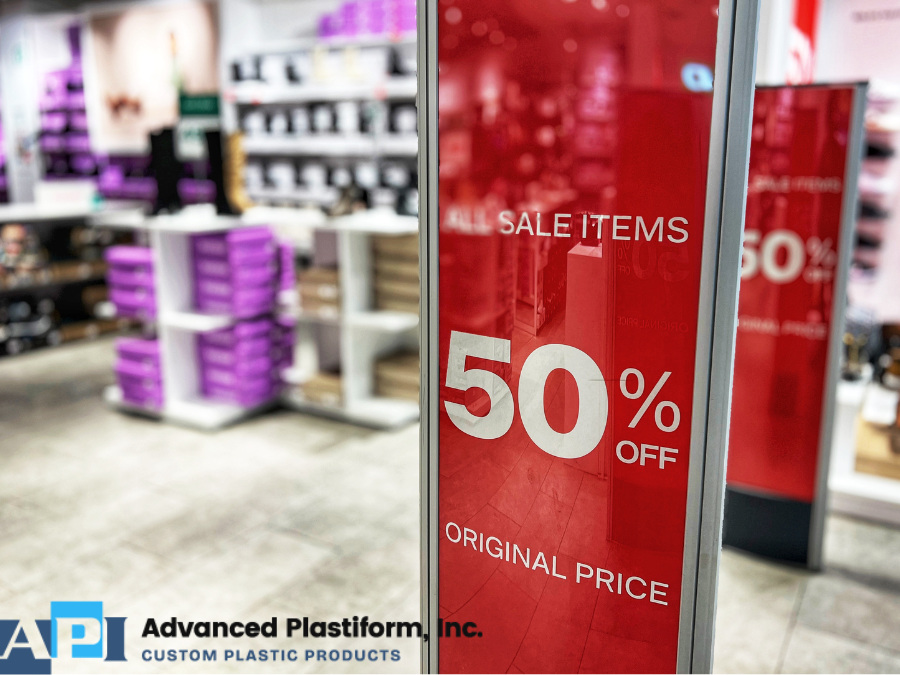
Signage systems and display panels often rely on thermoformed parts for support and structure. These components need to hold graphics in place while maintaining a clean surface that does not distract from the branding. Consistency across panels is especially important when displays are installed across multiple locations at the same time.
How Different Thermoforming Processes Apply to Retail Displays
Choosing the best manufacturing method for retail display plastics early in the process helps avoid issues with fit, appearance, or durability once the display is in use.
Vacuum Forming for Straightforward Components
Vacuum forming is often used to build parts for trays, inserts, and other components where the shape is relatively simple.
During this process, heated plastic is pulled over a mold, allowing it to form to the surface with consistent thickness. This approach works well for larger production runs where repeatability and efficiency take precedence over finer details.
Pressure Forming for Refined Display Surfaces
When displays require sharper definition or a more finished appearance, pressure forming is typically used.
This process applies additional pressure during forming, allowing the material to capture finer details from the mold. It is often selected for branded displays where the visual finish needs to hold up long-term.
Twin-Sheet Forming for Structural Strength
Twin-sheet forming is used for displays that need added strength without becoming overly heavy.
During manufacturing, two sheets of plastic are formed at the same time and joined together, creating a hollow structure that adds rigidity. This makes it a practical option for larger fixtures that need to support weight while still being easy to move and install.
Materials Used in Retail Display Thermoforming
To make sure that retail displays stand up over time, it's important to consider the best material choice for the project. This is because different plastics offer various levels of strength, clarity, and impact resistance. Selecting the best material comes down to considering how the display will be used, how long it needs to last, and the type of environment it will be placed in.
Common materials used when producing retail display signs are:
- Acrylonitrile Butadiene Styrene (ABS): ABS is known for its strength and durability, often used for structural components and larger retail displays.
- High Molecular Weight Polyethylene (HMWPE): A durable, impact-resistant material used for components, HMWPE allows for repeated handling and movement. It is often selected for trays, bins, and high-use parts where wear and friction are a concern.
- Polyvinyl Chloride (PVC): Offering good chemical resistance, PVC is commonly used in retail signage and display panels.
- Acrylic: When a display’s visual clarity is important, acrylic provides a glass-like appearance that keeps products visible while remaining lightweight.
- Thermoplastic Olefin (TPO): A flexible, impact-resistant material that performs well in displays. TPO can be exposed to regular handling and movement, especially where cracking needs to be avoided.
Request a Quote for Retail Display Thermoforming
If you are evaluating options for retail display manufacturing, it helps to work with a team that understands how these products perform outside of the production floor.
Advanced Plastiform Inc. works with companies across multiple industries across North Carolina, South Carolina, Pennsylvania, Maryland, Tennessee, and Georgia. Whether you are developing a new display or refining an existing design, the process starts with understanding how the display will be used.
To speak to a member of our team and get a quote on your project for plastic retail signage, call 919-404-2080 or fill out our contact form.
"*" indicates required fields