The Color Matching Process for Injection Molding
During the injection molding process, manufacturers achieve precise color matching for plastic parts by tightly controlling materials, colorants, processing conditions, and quality checks from the start of the project. While the physical quality of a part is vital, that makes up for only half the equation—its appearance is just as important, especially when brands depend on color consistency across product lines.
Even when two plastic parts are molded from the same resin, small changes in lighting, temperature, or material behavior can shift the final shade. Because of this, precise color matching is one of the most technical and detail-heavy steps in developing an injection molded plastic component.
Join our injection molding company, Advanced Plastiform Inc., as we outline how manufacturers control these variables to produce accurate, high-quality, color-consistent plastics.
Benefits of Accurate Color Matching In Injection Molding
Accurate color matching delivers more than a good-looking part—it directly supports product performance, manufacturability, and brand consistency across every production run. Before a color formula is approved for mass production—or any scaled manufacturing phase—engineers evaluate how that color will behave in the mold, in the field, and across future orders.
Color Enhances Product Performance and Reliability
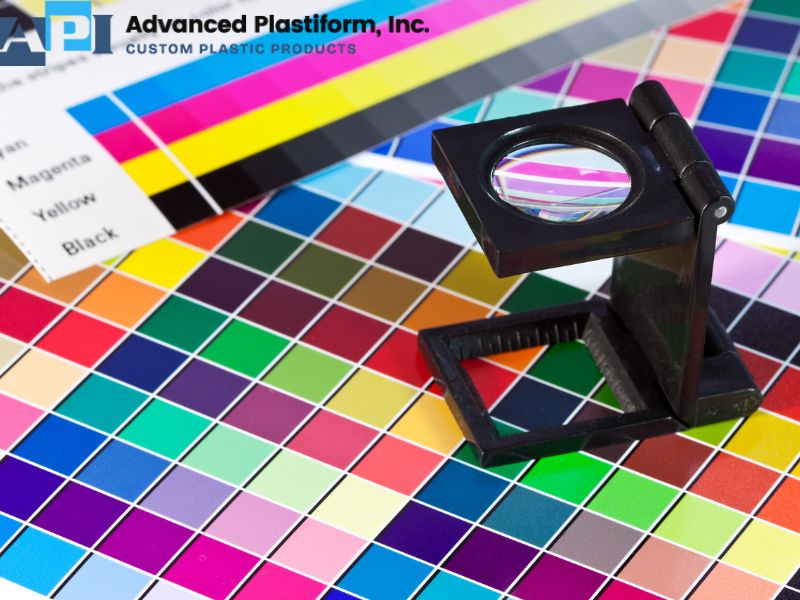
A precisely matched color helps ensure the plastic part performs the way it was designed, not just how it looks. Pigment and resin combinations influence heat absorption, UV stability, and resistance to chemicals or cleaning agents—factors that are crucial in medical devices, automotive components, consumer products, and outdoor applications.
When color is engineered with performance in mind, plastic components stay closer to their intended appearance and function over time, reducing the need for premature replacement.
Accurate Color Matching Streamlines Manufacturing
Even small visual differences can interrupt assembly workflows or trigger quality-control rejections. Off-color parts must often be reworked or scrapped, increasing injection molding costs and slowing production.
In contrast, consistent color reduces scrap, rework, and inspection delays by keeping parts within visual specification from the start. Before mass production can begin, a stable color formula allows molding teams to move through sampling and validation more efficiently, without repeated adjustments or line stoppages. This stability helps assemblies go together smoothly and reduces the risk of mismatched parts reaching customers.
Stable Color Formulas Support Long-Term Brand Consistency
For branded products, accurate color matching keeps parts aligned with established brand standards across multiple tools, suppliers, and production runs.
When resin selection, pigment loading, and cooling system settings are documented and controlled, future orders can be reproduced with the same visual impact as the original launch. This long-term color stability strengthens brand recognition and helps companies avoid the redesigns or relabeling efforts that come from inconsistent appearance, ultimately reducing costs of injection molding processes.
The Injection Molded Plastics Color-Matching Process
Color matching is a step-by-step workflow that creates a color formula that can be reproduced reliably across every production environment.
Step 1: Establishing a Color Target
The process begins by reviewing color references such as Pantone guides, RAL numbers, digital color values, or physical chips. These standards give formulators a precise baseline for hue, brightness, and saturation before any pigment is selected.
Step 2: Choosing the Best Type of Colorant
Depending on resin type and part performance needs, formulators may choose pigments, masterbatch concentrates, or fully compounded pre-colored resins. Each behaves differently during molding, and selecting the correct material at this stage improves consistency during scale-up.
Step 3: Producing Sample Plaques or Test Parts
Small test samples are molded using the intended resin and initial color formula. These plaques reveal how the color behaves at molding temperature, how it flows across the cavity, and whether adjustments are necessary to correct undertones or saturation levels.
Step 4: Documenting a Repeatable Formula
Once the sample is approved, the formula is documented alongside processing parameters, resin lot information, colorant ratios, and environmental conditions. This documentation becomes the blueprint for future production runs, ensuring color stays within tolerance.
Key Factors That Influence Final Color Appearance
Even with a well-designed formula, certain variables can alter the final look of an injection molded part. Understanding how these factors behave is essential for predicting color stability.
Resin Characteristics
Every plastic resin interacts with pigment differently. Semi-crystalline resins scatter light in distinct ways, while amorphous materials provide a more uniform surface appearance. The natural base color of the resin also influences how pigments render in the final part.
Additive Packages and Performance Modifiers
Additives such as UV stabilizers, flame retardants, and fillers can influence pigment distribution and opacity. For example, glass fibers may create subtle directional shading, while talc or mineral fillers can lighten or dull the final appearance of the plastic component.
Processing Temperatures and Melt Behavior
Pigments must survive the heat and shear generated during plasticization. Overheating can degrade pigments and wash out color, while insufficient mixing can leave streaks or inconsistencies. Keeping melt temperature consistent is critical for accuracy.
Mold Surface Finish and Texture
Because light interacts differently with glossy, matte, and textured surfaces, mold finish affects how the final color is perceived. Medical, cosmetic, or consumer-facing parts often require combined evaluation of both color and surface finish to ensure alignment with design expectations.
Common Approaches to Color Matching in Injection Molding
Different projects call for different color-matching strategies. Each method offers its own advantages depending on production needs, part complexity, and material behavior.
Pre-Colored (Compounded) Resin
Pre-colored resin provides excellent batch-to-batch stability because pigment is dispersed during compounding rather than at the press. This method is ideal when tight visual tolerances or large production volumes require consistent results.
Masterbatch Concentrates
Masterbatch offers flexibility and cost efficiency. Because it allows color adjustments at the molding machine, it remains a popular choice for multi-material product lines or moderate-volume programs.
Liquid Color Systems
Liquid color disperses quickly, offering strong color saturation and vibrant tones. It is often used for translucent parts or applications requiring subtle visual transitions or specialty effects.
Start Your Injection Molding Project With a Trusted Color-Matching Partner
Achieving precise color in injection molding requires the right blend of material science, processing expertise, and quality control. At Advanced Plastiform Inc., our engineering team works closely with clients to develop color formulas that remain consistent across every production run.
To learn more, contact us by calling 919-404-2080 or filling out our contact form to get started.
We proudly serve customers throughout the Southeast, including those in North Carolina, South Carolina, Pennsylvania, Maryland, Tennessee, Georgia, and Virginia.