Thermoforming offers fast lead times and low initial start-up costs, making it an ideal manufacturing…
Thermoforming for Custom Plastic Boat Parts
Marine plastics produced through custom plastics manufacturing provide boat and marine equipment manufacturers with a reliable way to build lightweight, repeatable parts designed for coastal use. While hulls are typically fiberglass, many functional components inside a vessel—helm panels, storage liners, seat substrates, equipment housings, and access covers—are better suited to thermoformed plastics.
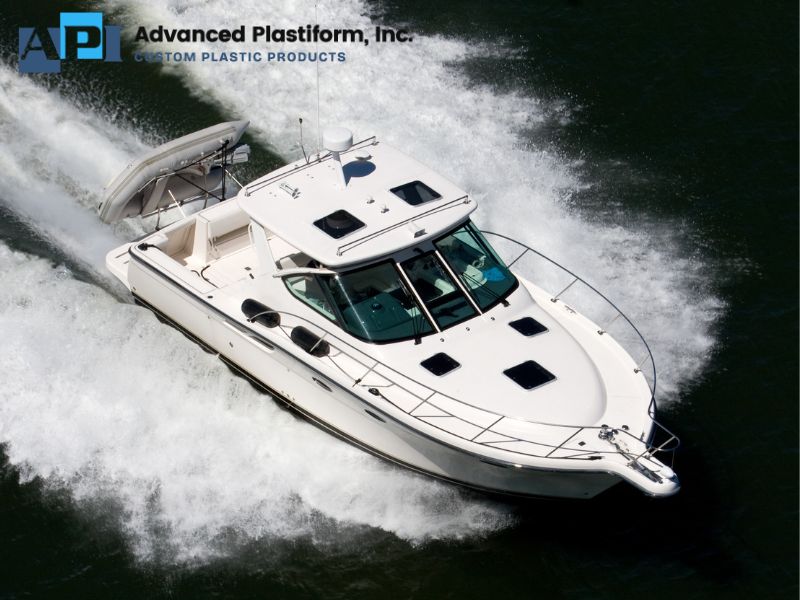
These parts don’t sit in open water, but they still deal with moisture, vibration, cleaners, and daily handling. Thermoforming enables manufacturers to produce consistent components at practical tooling costs and predictable lead times.
Join Advanced Plastiform Inc. as we explore practical uses for marine plastics in modern boat and marine equipment manufacturing.
Where Thermoformed Plastics Are Used in Boat Manufacturing
Marine-grade parts must withstand humidity and salt exposure without warping or looking worn. Thermoforming offers a practical alternative, producing strong, well-finished components with complex shapes without the added weight of fiberglass.
Here are some of the common modern-day uses of engineered plastics for boats:
- Interior wall panels and liners
- Electronics housings and dash surrounds
- Fish boxes and live-well components
- Seat backs, bases, and storage lids
- Battery trays and mechanical covers
Marine Plastics Built for Real Ocean Conditions
Boats don’t usually age gently. The reason is that they vibrate through chop, bake in direct sunlight, and are rinsed with saltwater repeatedly.
Materials for marine use need to be capable of handling:
- Constant exposure to moisture
- UV resistance to prevent chalking and discoloration
- Impact resistance when gear gets tossed around
- Chemical resistance from cleaners and fuel
- Dimensional stability in wide temperature ranges
Thermoformed plastics can be customized to suit these environments, with options for additives, textures, and gauges to meet those demands.
Thermoforming Processes That Fit Marine Parts
Every boat component has its own personality—some need crisp detail around gauges while others require hollow, structural forms. At Advanced Plastiform Inc., our custom boat plastic engineers tailor each project’s process to the part and how it needs to perform.
Here are some manufacturing methods we may use to produce durable marine plastics.
Pressure Forming
Pressure forming is a method that uses both heat and positive air pressure to push a plastic sheet tightly against a precision mold. The added pressure captures fine textures, crisp edges, and detailed features that resemble injection-molded parts—without the same tooling costs or extended lead times.
Project Example: Helm Surround Panel
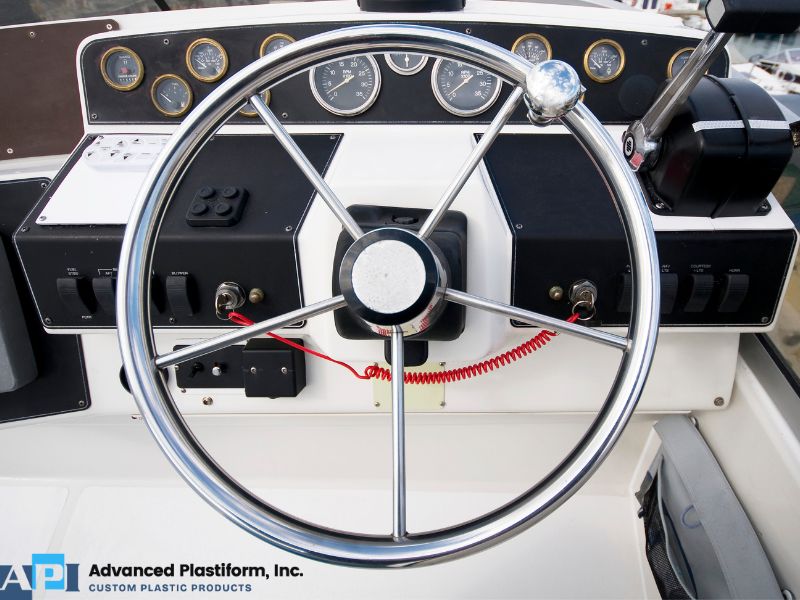
A helm surround holds the gauges and switches at the boat’s console, so it needs to fit tight, look clean, and feel solid when buttons are pressed. Pressure forming shapes the plastic to match the dash opening, ensuring a consistent finish and panels that drop into place without rework and remain stable through daily use.
The Result: High-Detail Cosmetic Control Parts
- Panels with crisp edges and clean surface texture that match the rest of the boat's interior
- Accurate openings for gauges, switches, and screens that fit without trimming
- Rigid parts that don’t flex when controls are pressed
- Consistent pieces from boat to boat, reducing hand-fitting on the line
Vacuum Forming
Vacuum forming uses heat and suction to pull a plastic sheet over a mold. It’s a straightforward, dependable process that works especially well for larger parts where smooth surfaces and coverage matter more than tiny cosmetic details. The method keeps tooling costs reasonable and allows quick changes when a design needs to evolve.
Project Example: Cabin Storage Liner
A cabin storage liner shapes the inside of lockers and compartments where gear, lines, and personal items are stored. The liner needs to be smooth, easy to clean, and sized to follow the curves of the boat interior without trapping water. Vacuum forming produces this part as a single piece, replacing multiple flat panels and providing installers with a clean, drop-in component.
The Result: Large One-Piece Interior Panels
- Seamless liners that cover broad areas without joints or gaps
- Lightweight parts that are easy to handle during assembly
- Smooth surfaces that wipe down quickly after everyday use
- Cost-efficient components for high-volume production runs
Twin Sheet Forming
Twin sheet forming simultaneously heats and bonds two plastic sheets within the mold to create a hollow, enclosed structure. This approach strengthens the part without adding solid thickness, making it ideal for marine plastics that require rigidity while remaining lightweight.
Project Example: Insulated Fish Box or Seat Base
A fish box or seat base must be sturdy, moisture-resistant, and able to control weight. Twin sheet forming produces inner and outer walls in one cycle, creating built-in spaces for insulation, drainage channels, or hardware inserts. The finished piece installs as a complete unit rather than a collection of separate parts.
The Result: Rigid Hollow Structural Components
- Strong parts that hold shape without heavy fiberglass layups
- Enclosed cavities for insulation, flotation, or mounting hardware
- Clean interiors that handle regular washes
- Integrated features formed directly into the part
Choosing the Right Material for Marine Plastics
Each type of resin behaves differently under heat, salt, and mechanical stressors. Advanced Plastiform Inc.’s engineering team helps boat builders balance appearance, cost, and service life when choosing the best materials for marine plastic manufacturing.
Here are some of the materials we work with that are commonly used in marine environments:
- Acrylonitrile Butadiene Styrene (ABS): Tough, paintable, and dimensionally stable for interior trims.
- High Impact Polystyrene (HIPS): Economical option for non-structural liners.
- High Molecular Weight Polyethylene (HMWPE): Excellent impact and moisture resistance.
- Polypropylene (PP): Chemical resistance for fish boxes and areas that accumulate a lot of moisture.
- Thermoplastic Olefin (TPO): Durable surfaces with good UV performance.
- Polycarbonate (PC): High strength for clear or impact-critical parts.
- Polyvinyl Chloride (PVC): Moisture-tolerant and easy to fabricate.
- Acrylic: Glossy, UV-stable cosmetic finishes.
Benefits of Working with Advanced Plastiform for Your Custom Marine Parts Project
Advanced Plastiform Inc. approaches projects that involve custom marine plastics with practical experience—what rattles, what fades, and what installers actually need on the line. Our thermoformed components deliver automotive-grade precision to the boating industry without sacrificing the ruggedness required for ocean use.
Whether you’re launching a new model or updating an existing layout, our experienced team helps translate your ideas into plastic boat parts that fit, finish, and last over the long term.
Collaborative Design
We start with how the part will live on the boat, not just how it looks on a screen. Our engineers review CAD files and recommend draft angles, materials, and textures that align with real-world conditions.
Efficient Prototype Development
Tooling shouldn’t lock a builder into one idea. Our low-cost thermoforming tools enable prototyping with quick revisions, allowing you to test a console panel or liner on an actual boat before full production.
Consistent Production
Boat lines move fast, and hand-fitting parts slows everything down. Once a design is approved, we form and trim the plastic parts to meet repeatable standards, ensuring the tenth or hundredth boat component looks just like the first and second ones.
Logistics That Match Build Schedules
Manufacturing of marine plastics is driven by seasonal cycles and launch dates. Our team will work with you to plan around your assembly timeline, delivering parts in manageable quantities instead of filling warehouse aisles with pallets. You get what you need, when you need it.
Contact the Thermoforming Experts at Advanced Plastiform for Custom Marine Plastics
From first prototypes to full production runs, Advanced Plastiform Inc. helps boat manufacturers create durable interior parts that assemble easily and perform season after season. Bring us a drawing, a sample part, or simply an idea, and we’ll help you turn it into a reliable, production-ready marine component.
Contact us today to discuss your project and learn more by calling 919-404-2080 or filling out our online contact form. We proudly serve clients throughout the Southeast, including Virginia, North Carolina, Tennessee, Pennsylvania, Georgia, South Carolina, and Maryland.